
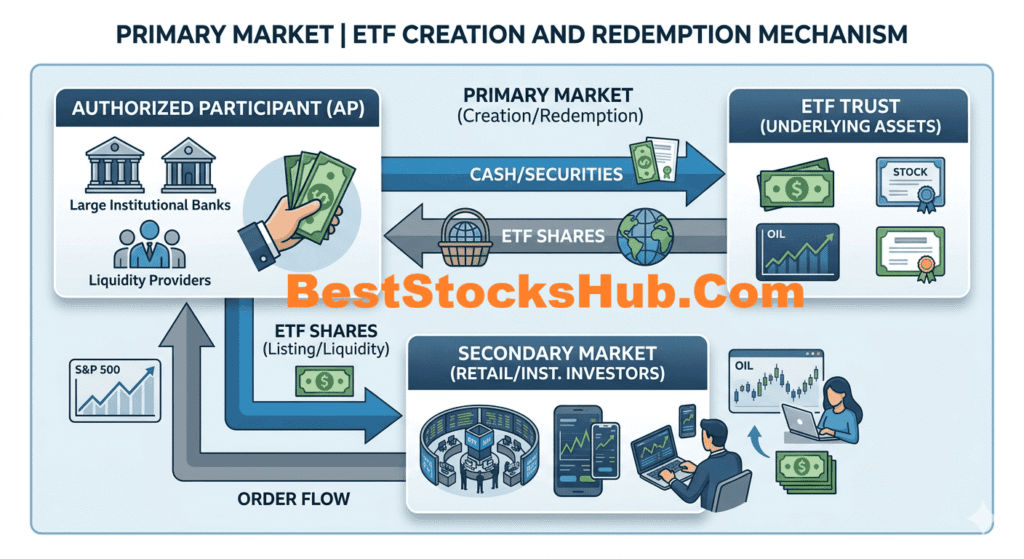
The world of modern finance offers everyday individuals unparalleled tools for personal wealth creation. Historically, building a balanced investment portfolio required vast capital reserves, complex broker interactions, and significant manual management. Today, a single vehicle has changed this landscape: the Exchange-Traded Fund (ETF). This comprehensive ETF investing guide serves as a complete strategic framework for beginners who want to invest their hard-earned money safely, manage market risks, and build long-term financial security. Whether you want to understand fundamental market mechanics or deploy your very first dollar, this foundational investing guide provides the exact blueprint to start your etf investing journey with absolute confidence.
1. Why Beginners Should Start with an ETF S&P 500
When entering the financial markets, new investors face an overwhelming number of individual stock choices. Buying single shares of separate companies exposes your capital to high concentration risk, meaning your financial security depends entirely on the performance of a few corporate executives. To bypass this vulnerability, experienced market participants rely on a diversified index fund as their core asset allocation, with the premier option being an ETF S&P 500.
An ETF S&P 500 is a pooled investment vehicle designed to automatically mirror the performance of the Standard & Poor’s 500 Index. This historic index tracks 500 of the largest, most structurally stable publicly traded corporations in the United States, spanning sectors from technology and healthcare to financials and consumer goods. When you buy a single share of this type of fund, your money is instantly distributed across corporate giants like Apple, Microsoft, Amazon, and Berkshire Hathaway based on their total market weight.
This structure provides immense structural benefits for retail portfolios:
Instant Diversification:
A single purchase divides your capital across 500 separate companies, ensuring that a failure in one specific business will not collapse your entire portfolio.
Ultra-Low Operational Costs:
Because these funds use an algorithmic computer model to track the index rather than expensive active fund managers, they feature incredibly low annual management fees.
Consistent Historical Returns:
Over long periods, the broad US stock market index has historically delivered an average annual return of roughly 7% to 10% after adjusting for inflation, outperforming the majority of actively managed professional funds.
Tracking the Market with ETF S&P 500 Funds
As you begin navigating your online brokerage platform, you will encounter multiple fund options utilizing the specific ETF S&P 500 designation. Various global asset management firms issue their own versions of this index fund, which are identified by unique, short alphabetic codes known as ticker symbols.
While these different ETF S&P 500 variants track the exact same basket of 500 underlying American corporate stocks, they can differ in key operational metrics that affect your long-term returns:
The Expense Ratio:
This represents the annual percentage fee deducted automatically from your fund balance to pay for administrative operations. Top-tier index providers offer expense ratios as low as 0.03%, meaning you only pay $3 per year for every $10,000 invested.
Liquidity and Daily Trading Volume:
High trading volume ensures that the gap between the buying price and selling price (the bid-ask spread) remains fractions of a penny, allowing you to convert your assets back into liquid cash instantly.
The Tracking Error:
This measures how accurately the fund’s price matches the movement of the actual underlying index. Renowned institutional issuers maintain near-perfect tracking accuracy.
Is an ETF S&P 500 Safe for Long-Term Growth?
To evaluate if an ETF S&P 500 aligns with your safety requirements, it is vital to distinguish between two distinct types of financial risk: unsystematic risk and systematic market risk.
An index fund completely eliminates unsystematic risk. If a single corporation within the index suffers an operational disaster, experiences a leadership scandal, or enters bankruptcy, the remaining 499 healthy companies shield your portfolio from catastrophic loss. However, an index fund remains exposed to systematic market risk. If a global economic recession occurs, the entire stock market drops, causing your fund share price to decline temporarily alongside it.
For long-term capital growth, history shows that the market eventually recovers from these macroeconomic downturns and moves on to reach new highs. By maintaining a multi-year time horizon, reinvesting your periodic dividend distributions, and avoiding panic selling during short-term market corrections, an index-tracking fund represents one of the safest, most reliable vehicles for compounding your wealth over time.
2. Understanding Commodity Funds: What is an USO ETF?
While equity index funds serve as the bedrock growth engine for a portfolio, advanced investors often look to alternative asset classes to diversify their holdings. A major area of expanding interest is the commodity market, highlighted by specialized vehicles like the USO ETF
The USO ETF, known formally as the United States Oil Fund, is an exchange-traded vehicle designed to track the daily price movements of light, sweet crude oil. Unlike a standard equity fund that owns physical shares of corporate businesses, this fund interacts directly with the energy markets. It provides investors with direct exposure to the fluctuations of the oil market without requiring them to navigate complex commodities brokerages or store physical barrels of raw fuel.
The underlying mechanics of this asset class rely on financial derivatives called futures contracts:
The Tracking Mechanism:
Instead of buying physical oil, the fund purchases near-month futures contracts for West Texas Intermediate (WTI) crude oil.
The Rolling Process:
Because futures contracts have expiration dates, the fund manager must continuously sell the expiring contracts and purchase contracts for the following month. This process is called “rolling” the contracts.
Contango and Backwardation:
If the price of oil for delivery next month is higher than the current month’s price (a market condition known as contango), the fund experiences a minor financial loss during the rolling process. This structural cost can cause the fund’s long-term performance to deviate from the actual spot price of physical oil over extended periods.
Because commodities often move independently of traditional stock and bond markets, vehicles like the USO ETF are frequently utilized as tactical short-term hedges against global inflation or as speculative tools during geopolitical supply shocks. However, due to the unique structural costs of rolling futures contracts, these instruments require close monitoring and are generally less suited for passive, decades-long “buy-and-hold” retail strategies.
.
3. Broadening Your Portfolio with MSCI and SET100 Funds
A truly resilient financial foundation should extend past the borders of any single country. True diversification means exposure to diverse geographic regions, varying currency movements, and localized economic expansions. To achieve international diversification, investors use broad international benchmarks like MSCI indices, alongside specialized regional choices such as the SET100.
The Power of MSCI Global Benchmarks
The Morgan Stanley Capital International (MSCI) index suite acts as the global standard for tracking international equities. Instead of limiting your investments to American companies, you can buy a single international fund that tracks the MSCI World Index or the MSCI Emerging Markets Index.
Developed Markets:
Exposure to stable, industrialized economies across Europe and Asia Pacific, including Japan, Germany, France, and the United Kingdom.
Emerging Markets:
Direct access to rapidly expanding consumer economies like India, Brazil, and volatile high-growth regions.
Integrating Regional Fixed Income and Equities
For investors looking to capture emerging opportunities in Southeast Asia, regional indices like the SET100 provide a structured gateway. The SET100 tracks the top 100 largest, most liquid publicly traded corporations on the Stock Exchange of Thailand.
Integrating regional funds introduces a balanced mix of financial instruments into your portfolio:
Equity Instruments:
Represents corporate shares within the index, driving long-term capital growth through industrial expansion, technological adoption, and regional consumer spending.
Fixed Income Instruments:
Provides portfolio stability through corporate and government bonds, offering regular interest payments to shield your capital during equity market corrections.
By blending a solid foundation of domestic assets like an ETF S&P 500 with broad international MSCI market coverage and targeted regional allocations like the SET100, you eliminate geographic single-point-of-failure risks. This comprehensive approach ensures your personal wealth remains supported by the continuous growth of the global economy.
4. How to Start Your ETF Investing Journey: Execution Blueprint
Transitioning from asset theory to market execution requires a structured, orderly roadmap. Follow these steps to set up your account and execute your first fund purchase safely.
Step 1: Open and Fund a Regulated Brokerage Account
To trade public securities, you must select an online investment platform. Compare modern digital brokerages to find one that fits your needs:
Zero Commissions: Ensure the platform charges no transactional fees for standard fund trades.
Fractional Share Support: Select a broker that allows you to buy fractions of a share, letting you invest exact dollar amounts (e.g., investing $50 directly into a fund trading at $400).
Security Infrastructure: Look for platforms featuring robust two-factor authentication (2FA) to protect your capital.
Once you pick a broker, complete the registration by providing your identity documents, tax information, and linking your traditional bank account to make your initial cash deposit.
Step 2: Establish Your Target Asset Allocation
Before purchasing any shares, define your investment strategy based on your age, risk tolerance, and time horizon:
The Aggressive Strategy: If you are young and saving for a retirement decades away, focus on long-term growth by allocating 80% to 100% of your capital into equity baskets like an etf sp500.
The Balanced Strategy: If you have a shorter time horizon or prefer lower volatility, mix your assets by allocating 60% to equities and 40% to stable fixed-income bond funds.
Step 3: Place a Market or Limit Buy Order
Log into your trading platform, type your selected fund ticker symbol into the search bar, and complete the order ticket details:
Market Order: Executes your trade instantly at the current prevailing market price. This is ideal for long-term investors looking to deploy capital immediately.
Limit Order: Lets you specify the exact maximum price you are willing to pay per share. The trade will only execute if the fund’s market price hits your specified target.
5. Strategic Blueprint: How Many Funds Should You Own At Once?
A common mistake made by beginners is buying too many separate funds, which can lead to over-diversification and inefficient portfolio overlap.
The Problem of Fund Overlap
If you purchase an S&P 500 fund issued by Vanguard, another S&P 500 fund issued by iShares, and a third from State Street, you have not multiplied your diversification. You have simply purchased the exact same 500 American corporate stocks across three different financial brands.
Similarly, if you hold a broad total-market index fund alongside a specialized technology sector fund, you are unintentionally over-weighting tech companies like Microsoft, Nvidia, and Apple, which are already heavily represented in the broad index. This redundancy can increase your portfolio’s exposure to sector-specific market crashes.
The Efficiency of the 3-Fund Portfolio
For the majority of retail investors, an optimal, institutional-grade global portfolio can be constructed using just one to three total funds:
| Fund Type | Core Role in Portfolio | Target Market Exposure |
|---|---|---|
| 1. Domestic Equity Index | Core Growth Engine | Broad exposure to the domestic economy via an ETF S&P 500. |
| 2. International Equity Index | Geographic Diversification | Developed and emerging international markets via MSCI benchmarks. |
| 3. Total Bond Market Index | Capital Preservation & Income | Government treasuries and corporate bonds to reduce overall volatility. |
By focusing your capital on a few comprehensive index products, you minimize unnecessary management fees, eliminate asset redundancies, and make portfolio management simple.
Implementing Dollar-Cost Averaging
Rather than trying to time the market to buy at the perfect low point, long-term success is built through consistency using a strategy called dollar-cost averaging (DCA).
With DCA, you invest a fixed amount of cash on a regular schedule (such as $100 every month), regardless of whether the stock market is rising or falling. When prices drop, your fixed dollar amount automatically purchases more fractional shares of the fund. When prices rise, your fixed cash amount buys fewer shares. This automated approach removes emotional bias from your investing, reduces the impact of short-term market swings, and builds a powerful wealth-compounding engine over time.
Technical Disclaimer
This guide is provided for educational and informational purposes only. It does not constitute personalized financial, investment, legal, or tax advice. Investing in financial markets involves inherent risks, including the potential loss of principal capital. Past performance of indices or funds is no guarantee of future financial results. Investors should conduct independent research or consult with a licensed financial professional before making investment decisions.